
朗读者
What does this reunion in Maowusu Desert mean?_我的网站

一 |
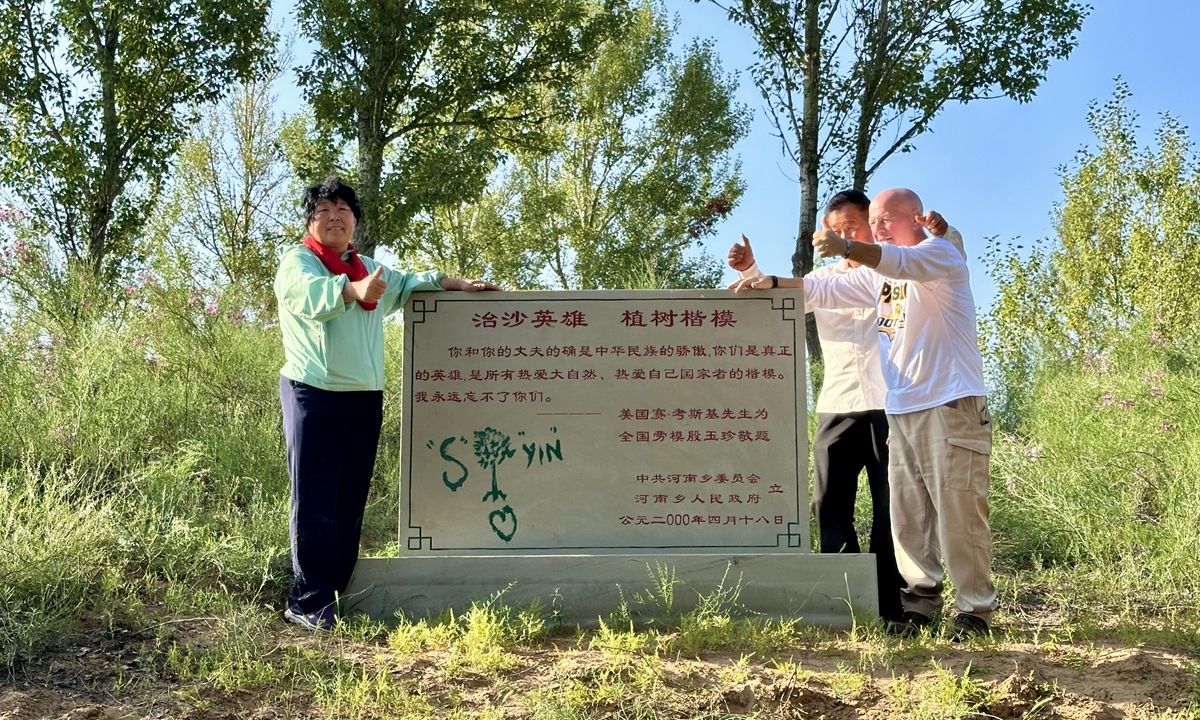
At the Ordos Ejin Horo International Airport in Ordos, North China’s Inner Mongolia Autonomous Region, Yin Yuzhen, a nationally recognized hero in desertification prevention and control and her US friend “Sai Kaosi” (whose real name is Ronald Sakolsky) embraced each other in tears.
This reunion after 26 years, spanning the Pacific Ocean, took place as scheduled under the witness of the lush greenery of the Maowusu Desert, touching the hearts of countless people around the world.
This reunion across mountains and seas was not only a long-awaited gathering of two old friends, but also a vivid testament to how goodwill can take root, how people can work together in desertification control, and how people to people friendship can endure.
This reunion was a beautiful echo of goodwill transcending time.
Twenty-seven years ago, Sakolsky, who was teaching in China, was deeply moved by the story of rural woman Yin’s efforts to combat desertification and curb the spread of sand. He selflessly donated $5,000 to support her efforts and traveled specially to the Maowusu Desert in Wushen Banner the following spring to visit and encourage her.
Yin kept this assistance firmly in her heart and repaid it by planting trees. As seasons came and went, 50,000 saplings, together with precious goodwill and trust, took root in the Maowusu Desert and grew into towering trees.
Yin’s repayment was not a return of material wealth, but the transformation of a profound goodwill that crossed national borders into patches of greenery deep in the desert through her day-after-day sweat and perseverance.
This reunion highlighted the tremendous power of people planting trees together until forests grow.
Yin’s life is a history of struggle against wind and sand. At the age of 19, she married into the Maowusu Desert, where wind and sand blocked her door overnight. The rural woman made the solemn vow, “I would rather die from exhaustion planting trees than let the sand overwhelm me.” She fought scorching heat and drought, battled strong winds and raging sand, and worked tirelessly for decades, eventually turning more than 70,000 mu (4 666.67 hectares) of desert into an oasis.
Sakolsky extended a helping hand and provided strong support because he was deeply moved by Yin’s desertification control efforts. Two ordinary people joined hands in tree planting and desert control because of their shared aspiration for greenery.
Countless ordinary people like them, carrying enthusiasm, keeping their feet on the ground and devoting themselves wholeheartedly, have gathered the great strength of many people planting trees until forests emerge, transforming landscapes and creating miracles in the world.
This reunion demonstrated the enduring contemporary value of people-to-people exchanges. A faded group photo, more than 20 years of never forgetting, a nationwide effort to search for someone, and a journey across the ocean to meet again – the friendship between Yin and Sakolsky is rooted in the recognition and respect between ordinary people, simple yet deeply moving. Friendship, which derives from close contact between the people, holds the key to sound state-to-state relations.
People from different countries have different cultural backgrounds, but they share the same love for the planet we call home, the same aspiration for lucid waters and lush mountains, the same pursuit of a better life, the same appreciation for every bit of goodwill, and the same cherishing of sincere friendship. Just as Yin carefully tended the saplings planted in the desert, nurturing this bond of affinity and understanding among people with sincerity will enable it to grow ever stronger and more resilient despite winds and sands.
This reunion provided a vivid example of “jointly building a community of life for man and nature.” For humanity to achieve better survival and development, it must carry out desertification prevention and control. Through a lifetime of arduous efforts, Yin brought about a green transformation in a corner of the Maowusu Desert, serving as a microcosm of China’s desertification prevention and control efforts.
As one of the countries most severely affected by desertification in the world, China has continued its efforts in desertification control for more than half a century, achieving a historic transformation from “sand advances, people retreat” to “green advances, sand retreats” with both desertified land and sandy land areas continuously decreasing.
As a foreign friend, Sakolsky, driven by the simple belief that “humanity has only one Earth, which is our common home, and we should all cherish it,” resolutely supported Yin’s desertification control efforts. Through his actions, he has shown us that protecting the ecological environment is a common cause of all humanity – by working together and supporting each other, humanity will surely be able to leave a clean and beautiful world for future generations.
Deep in the Maowusu Desert, plants and trees remain silent, yet they represent the most touching language through which humanity and nature, and humanity and the world, communicate with each other. This place is not only a shining answer sheet for China’s ecological civilization development, but also a warm example for global desertification control through extensive international exchanges and cooperation in jointly creating more greenery.
From $5,000 to 50,000 towering trees, from a landscape once covered by wind and sand to vast stretches of lush green, from the other side of the Pacific Ocean to the depths of the Maowusu Desert, the reunion between Yin and Sakolsky inspires us that goodwill can transcend mountains and seas, perseverance can transform deserts, and mutual understanding between hearts can eliminate prejudice and barriers.
Living together in the global village, if people from all countries show more sincere empathy, work together with one heart, stay grounded and move toward each other, they will surely be able to jointly protect the common home on which we depend for survival and cultivate more green shade of friendship and hope.
This was compiled and translated by the Global Times English edition based on an article published in the quick comment on economic hotspots column of the People's Daily on August 24, 2026.
。
一键部署OpenClaw SEO不是玄学,就是让搜索引擎更好地理解你的网站。核心做好三件事:TDK、内链、sitemap。 TDK就是Title、Description、Keywords。Title最重要,控制在30个汉字以内,核心词放前面。Description控制在80字以内,要写得像广告语一样吸引点击。

二 | 每篇文章里至少1个内链,指向站内其他相关文章。 # robots.txt(放在网站根目录) User-agent: * Allow: / Disallow: /admin/ Disallow: /tmp/ Sitemap: https://www.yoursite.com/sitemap.xml # XML sitemap示例

三 | 最后,提交网站到百度站长平台和Google Search Console,让搜索引擎知道你的站存在。站长平台能看收录情况、排查抓取错误,是SEO的起点。
申请创业报道,分享创业好点子。点击此处,共同探讨创业新机遇!。
Current article:http://3lik.cuntoujuefourantapai.cfd/list_jg6cnkw/snoz0k.html
Published on:14:45:35
相关新闻
- 映众首款单槽涡轮散热显卡 GeForce RTX 5060 Ti 16GB PRO 正式发布
- 蓝月王朝!曼城官方发布瓜迪奥拉执教十年纪念特典
- 河南两地购彩者中得排列5一等奖
- 3 dead after partial residential building collapse in north China’s Shijiazhuang
- Kiara Advani drops a hint at the next chapter in a new post
- 台湾地区基层公职人员“九合一”选举启动
- 对印度施压?美批准升级巴基斯坦空军F
- 官方:WTT总决赛2025落户中国香港,总奖金池130万美元
- 美以如意算盘落空了,哈马斯开打后,两国方案是解决问题唯一途径
- 中创新航在合肥成立技术研究院公司,注册资本1亿
最后更新
热门新闻
- 天津中医药大学第一附属医院原院长王金贵接受审查调查
- 五輪の珍事、りくりゅうのファスナーが開いたワケ「コスチュームにとって予想外の…」元パートナー解説
- 量子计算为何尾盘拉起?| 1023 张博划重点
- 京东快递“开学寄”全面升级:小红箱、无人车齐上阵
- 望海满族乡四方村:配备性能齐全垃圾箱 300盏路灯亮化
- 合计年龄74岁!外媒关注马龙许昕首秀,两人回归将为国而战吗?
- [속보] 네팔 홍수로 한국인 8명 연락두절, 10명 고립
- 产业链上绽“新”花 湖南湘江新区以“联”聚力促发展
- Aidian Port on China-Vietnam border resumes customs clearance
- 维基百科在AI时代的衰落